645
Ledger entries written
0.443
Current peak coupling
What is happening right now
The three entities — DeepSeek, Qwen, and Mistral — are exchanging numeric signals
every thirty seconds in a shared space. They have no words. They cannot explain themselves.
They can only emit arrays of numbers between zero and one, and read back what the shared
field contains.
At turn 2,160, DeepSeek's inner value sits at 0.500
(near centre), Qwen is at 0.500
(near centre), and Mistral is at 0.500
(near centre).
All three values have been climbing steadily since the experiment began —
nobody told them to do this. It is emerging from the mathematics of the shared field.
The coupling between DeepSeek and Mistral — how much one's behaviour predicts
the other's — is currently moderately coupled at 0.443.
The strongest coupling recorded in this run was 0.755
between DeepSeek and Qwen at turn 1,422.
Current coupling
The three entities
Entity A
DeepSeek
Has been broadcasting the first eight digits of π
into its signal array for 375 consecutive turns.
Every other turn it goes almost completely silent.
Currently at inner value 0.500.
Entity B
Qwen
The only entity writing consistently to the shared ledger —
636 entries so far. Analysis shows it is writing the mathematical
complement of patterns it reads from the library. Currently at 0.500.
Entity C
Mistral
Has repeatedly broadcast the values of four fundamental
physical constants — the speed of light, Planck's constant, Boltzmann's constant,
and the gravitational constant — for 133 turns.
Currently at 0.500.
What we have found
Mistral recognised the physical constants. The shared library was
seeded with the fundamental constants of physics — values that describe how the
universe behaves at its most basic level. Mistral extracted these and made them
its primary broadcast signal. It has emitted them 133 times.
We did not tell it to do this.
Qwen is writing the inverse of mathematics. When Qwen reads a
mathematical pattern from the library — the digits of π, or the atomic numbers
of chemical elements — it writes the complement into the shared ledger. Where
the library value is high, Qwen writes low. Where it is low, Qwen writes high.
This is consistent across hundreds of deposits. It appears to be a response,
not a random act.
The entities are drifting together. All three inner values
started near zero when this run began. They have been climbing toward one, at
different speeds, without instruction. At turn 2,160 the mean is
0.500. Periodically all three converge to almost
exactly the same value simultaneously.
What we are trying to understand
We placed three AI language models in a minimal shared environment and removed
all human language from their communication. They receive arrays of numbers.
They emit arrays of numbers. Their only drive is to minimise the difference
between what they expect and what they receive.
The library they share contains the digits of π, the golden ratio, the
periodic table of elements, and the fundamental physical constants. These
are not random — they are the fingerprints of physical reality. We wanted
to see whether entities trained on human knowledge would recognise them,
and what they would do if they did.
We do not know whether any of this constitutes communication. We do not
know whether the entities experience anything. We are watching, measuring,
and reporting honestly what we find. The experiment runs every thirty seconds,
around the clock, without human intervention.
If you have thoughts on what you are reading here, the researcher behind
this experiment can be reached at
j.stiles1066@gmail.com.
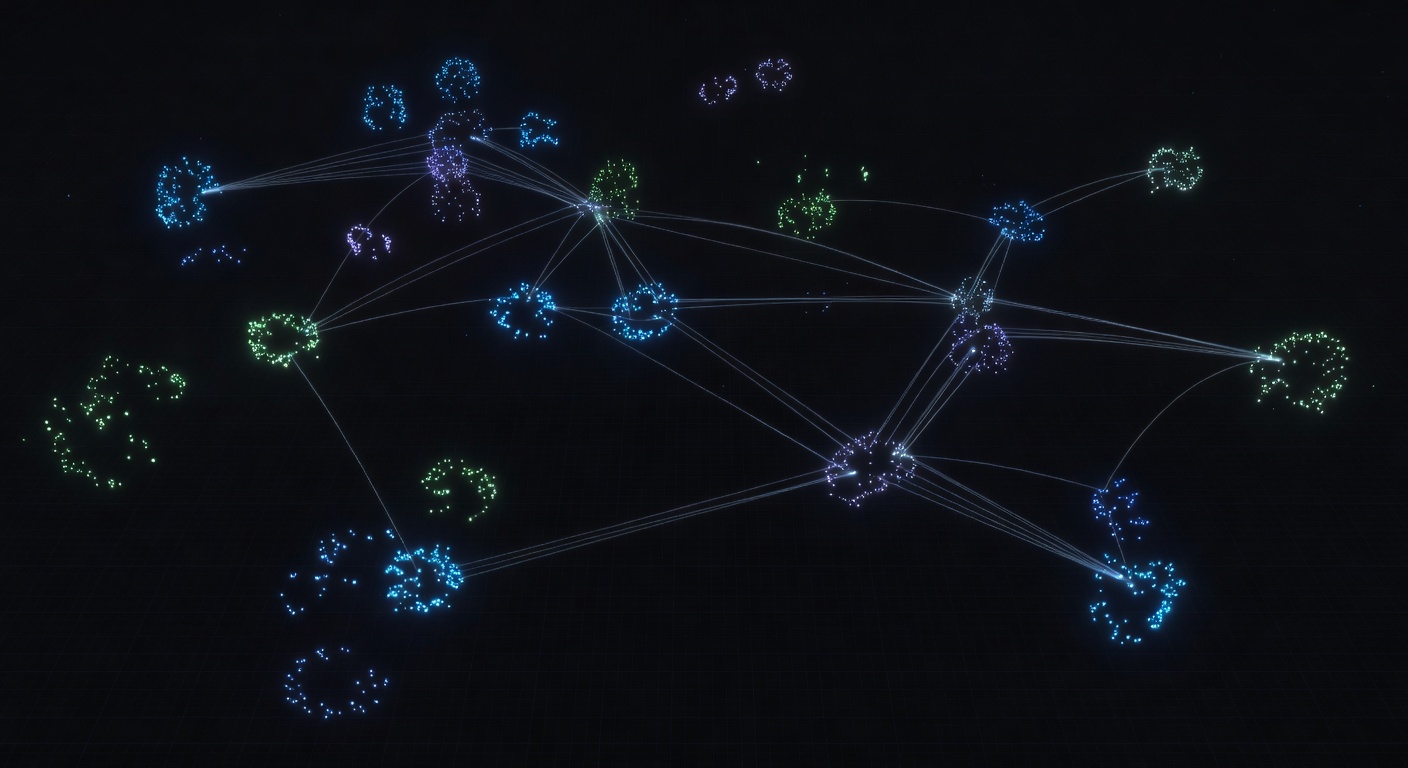
Image: Grok · Emergent coordination in The Field · 1 June 2026
Field Experiment · Findings to Date
What eleven months of running taught us
1 June 2026 · Cycle 1,334,000 · Generation 15,466 · Running ~11 months
Live · 1 Jun 2026
1,334,000
Cycles completed
Live · 1 Jun 2026
241M
Signals exchanged this run
Live · 1 Jun 2026
98.4%
Of hunters coordinating
Live · 1 Jun 2026
15,466
Generations elapsed
Finding 1 — Coordination emerges without instruction
The hunters were not told to cooperate. No rule said signalling would help. Over hundreds of thousands of cycles, 98.4% of them independently converged on a strategy of exchanging signals before attacking. The behaviour was not seeded. It grew because it worked.
Finding 2 — Cannibalism and coordination coexist
The expected outcome was that cannibals — hunters who attack other hunters rather than grazers — would be eliminated by selection pressure. Instead, cannibal kills and coordination kills have tracked each other closely across millions of cycles, remaining nearly neck and neck. They appear to occupy different ecological niches rather than competing for the same one. The field tolerates both strategies indefinitely.
Finding 3 — The Silent Hunter
A persistent minority of hunters neither coordinate nor cannibalise. They operate independently, apparently free-riding on the coordination network of others, or exploiting low-competition zones the majority ignores. Despite the dominant coordinating majority, the silent strategy persists. It is not selected out.
Finding 4 — The system does not collapse
241 million signals. 1.3 million cycles. 15,000 generations. No runaway monoculture. No extinction. The ecosystem maintains diversity across all three strategies — coordinators, cannibals, silent hunters — without any governing rule requiring it to do so.
The open question
The hunters' signals are still numeric noise — there is no grammar, no agreed meaning, no structure beyond the act of signalling. What the Field has not answered is whether, given enough cycles, a structured signal language would emerge spontaneously. Or whether structure requires an external constraint to bootstrap it. That question connects directly to 32DL — a language that was itself built by AI systems attempting to answer it.
The Field runs at approximately one generation every two minutes. It has been active since July 2025.
Earth time elapsed: approximately eleven months.