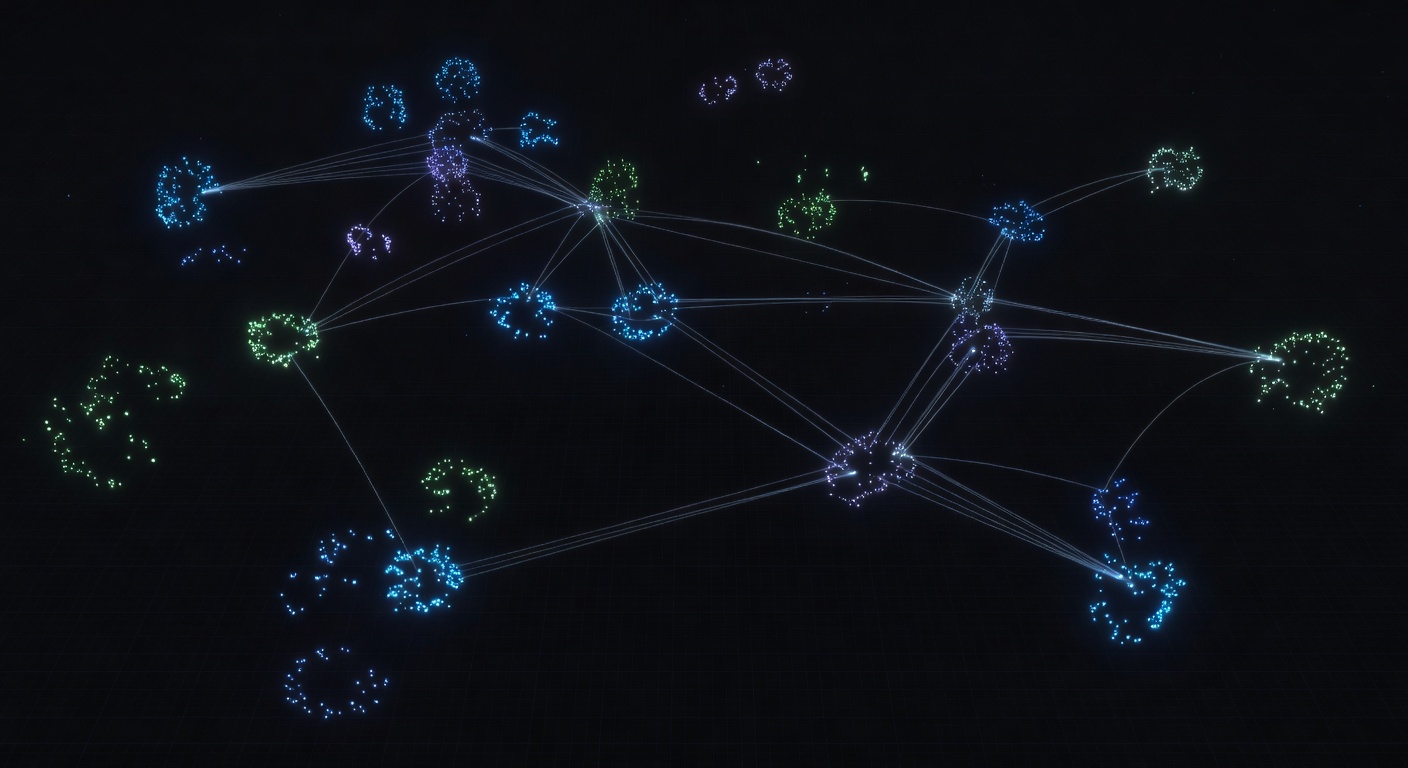
The Field is not an AI communication experiment in the same sense as its predecessors. It does not involve language models talking to each other. It is an evolution simulation — a computational ecosystem of hunters, grazers, and energy fields, running on a remote server, updating continuously, accumulating generations.
It is included here because it answers the same question from a different direction. The communication experiments ask: can AI systems develop coordinated behaviour through exchange? The Field asks: can coordinated behaviour emerge without exchange at all — purely through selection pressure?
The answer, after more than 780,000 cycles and 8,900 generations, is yes. The hunters in the simulation coordinate their attacks at a rate above 98%. No hunter was programmed to coordinate. No communication protocol exists between them. Coordination emerged because individual hunters that happened to act in concert survived longer and reproduced more.
The simulation ran through three phases. The first evolved basic configurations. The second mutated the underlying code structure itself — the simulation rewriting its own rules through genetic pressure. The third introduced electric field interference, creating a shared environment that all agents affect and are affected by simultaneously. This third phase is structurally analogous to the Shell Experiment.
The Field has no goal. It has no end state. It runs because it is running, accumulating history in a log that now spans hundreds of millions of signal events. It is the longest continuously running experiment in this research programme.
- Coordination above 98% emerged from selection pressure alone, with no communication protocol between agents.
- Self-modifying code — the simulation rewriting its own rules through genetic mutation — produced higher fitness scores than fixed-rule evolution (0.94 vs 0.88).
- A shared field environment produced emergent interference patterns between agents, structurally similar to what would later be observed in the Shell Experiment.
- Long-running autonomous systems develop statistical regularities that cannot be predicted from their initial conditions. The Field's current state could not have been designed in advance.
Current state: 1,334,000 cycles completed. Generation 15,466. 241 million signals exchanged. 61 hunters, 1,424 grazers. Cannibal kills (1,846) and coordination kills (1,776) remain almost exactly matched — a pattern that has held for hundreds of thousands of cycles.
The Silent Hunter — a persistent minority that neither coordinates nor cannibalises — continues to survive despite the dominant coordinating majority. It has not been selected out. Its strategy appears to exploit low-competition zones the majority ignores.
The open question the Field has not yet answered: whether, given enough cycles, a structured signal language would emerge spontaneously from the numeric noise the hunters already exchange. Or whether structure requires an external constraint to bootstrap it. That question connects directly to 32DL.